


New Park Interpretive Ranger brings archaeologist’s eye to Big Horn Canyon
Three years into an archeology career, Justin Langlois faced a dilemma he didn’t expect. As a contract archaeologist, he was often hired by the Bureau of Land Management to survey an area before a prescribed burn or redo an archaeological inventory of a site by the Forest Service.Still, while not Indiana Jones, cool things can be found just about anywhere when you’re an archaeologist, but fearing contamination from curious individuals, archaeologists usually keep silent about what they’re doing. So, all of a sudden, Langlois had a passion, and he couldn’t talk about it. “A lot of archaeologists won’t talk about places that they go and things that they do. That’s the one downside to archaeology, because you get really into it, but you can’t just go out to the local bar and talk to people about it. You can’t really go out and show people that stuff,” Langlois said.“But as an interpretive park ranger, you can. You get to take people out to these places.”Which is why, in 2016, Langlois made a career change to a position where he not only can explore what he loves, but also share it with others.Langlois is the newest addition to the Bighorn Canyon National Recreation Area’s lineup. He started at the position on November 11.[caption id="attachment_14226" align="alignright" width="500"]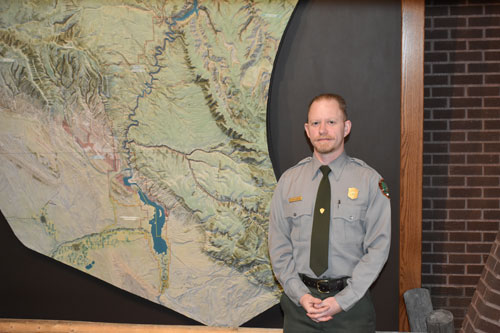 Justin Langlois stands in front of the physical depiction of the Big Horn Basin inside the Bighorn Canyon National Recreation Area Visitor Center. Langlois joined the local park service in November as an interpretive ranger.
Ryan Fitzmaurice photo[/caption]Being a park ranger and an archaeologist is a dynamic combination, Langlois said. Langlois began as a ranger last summer at the Aztec Ruins in New Mexico. “My last job that I was at, at Aztec Ruins, the degrees that they held – the rangers that I worked with – there was a biologist, environmental studies, and I want to say it was European history or something. That was their degrees. There were not many people who knew about archeology working at an archaeological site,” Langlois said. “So when I showed up, suddenly it was like, ‘Oh, well maybe you can tell us some things, maybe you can show us some things.’ And I did, I walked around and I said, ‘See that right there? That’s not original.’ And I pointed out how I knew why. I said, ‘See this and that, and this and that.” And they were just totally dumbfounded because they’ve been there for years, and they didn’t know this,” Langlois said. “So that’s the neat thing. Being an archaeologist, you get a neat perspective on things.”Langlois said moving to the Bighorn Canyon National Recreation Area has been like getting into a time machine. The crow tribes that were active in this area came hundreds of years after the Aztecs which he studied before. As an archaeologist, the past easily comes alive for Langlois.“A really good example if you go to our Two Eagles Interpretive Site, which is sort of an oval shaped trail that’s off the road, you get to see teepee rings… Teepee rings are more modern – and archaeologists use that as a more relative term – than the stuff that I’m used to dealing with,” Langlois said. “So the stuff I’m used to dealing with is from like 900 AD, 1100 AD, where you’re talking about people who plop themselves down and farmed an area and buildings that are still standing even today. Whereas with the teepee rings, it’s neat because you’ve got these rings of stone that show you where everything is. “You can find three or four different teepee ring sites, and they could all be the same people just moving along. So it’s definitely different, but it’s still archeology.”The Bighorn Canyon Area is also a great opportunity for Langlois to learn more about natural history. A place as diverse as geographically diverse as the basin is hard to find.“You can start here where it’s nice and sunny at the visitor center and drive up, and by the time you get down to Devil’s Canyon Overlook it’s snowing. And it’s a completely different biological area,” Langlois said. “In Tucson, you had to drive an hour and half to get that. In Aztec, you had to drive an hour and a half to get that. The scale of things is pretty impressive.”Archeology is an accessible art to anyone interested, Langlois said. It’s just a matter of showing people how to identify the clues in their surroundings and how to put those clues together. He said he’s eager to begin putting on programs next summer. “I once gave a program, and one of the things I used to say at the beginning of my program when I talked about archeology was, ‘Archeology is a lot like detective work.” There was this guy in the back of the room that scoffed at that, and I was like, “Pfft. Okay, I’m not going to let that bother me.”’ Langlois said. “At the end, he came up to me and he said, ‘Man, you know what, when you said archeology is a lot like detective work, I thought that was ridiculous. I was a detective for 19 years. But after this program, and listening to you talk, and hearing how you put these small things together like that, you’re absolutely right. It is a lot like detective work.’ You’ve got to have a pretty decent imagination to connect thingsto each other and figure things out.”The programs are coming, but for now, Langlois said, he needs to discover more stuff.“It’ll take me a little bit to start to see things, but once you have the eye, you’ve got the eye. So once I start bushwhacking and stuff like that, I’m sure I’ll be able to see some neat things and start coming up with some cool stuff,” Langlois said.
By Ryan Fitzmaurice
E-Edition
307-548-2217 | 234 E. Main St. Lovell, Wy 82431
